

Space & Invaders
Aliens journal

Dear Radio Free Pizza gourmets,
Wild year so far, huh? Sorry I’ve been out of touch: for many months now I’ve been mainly focused on trading options contracts to recover all the money I wish I’d spent on precious metals. But, I’m at least still keeping up a minimum of one post per month, even if none of them are the deep-dish dispatches that had previously been my signature. While the latest release of much-redacted Epstein files has once again made me regret my trademark username and title of this publication (“This even ruins pizza for me”)—though this doesn’t excuse my neglect in covering the U.S. Immigration and Customs Enforcement’s late-January execution of Alex Pretti in my hometown the week before—regardless, I’ve got a birthday at the end of this month, so it seems like a good occasion for another informal journal.
Anyway, maybe you’ve heard that last Thursday U.S. President Trump ordered the release of classified materials on extraterrestrial life. This came on the heels of a 14 February interview with former President Barack Obama, in which he called aliens “real.” Though he walked those comments back the next day, saying that he “saw no evidence during my presidency that extraterrestrials have made contact with us,” his successor—who notably established the U.S. Space Force in 2019—would soon claim that Obama “gave classified information” before directing his Secretary of Defense to prepare those documents for public consumption.
While some (such as talk-show host Seth Meyers) might have interpreted Trump’s order as an attempted distraction from his numerous appearances in the aforementioned Epstein files, I viewed it through the lens of a comedy sketch from a 2008 episode of The Whitest Kids U’Know.
In the sketch, a press conference disclosing the existence of a U.S. moon base ends with one intrepid reporter asking, “We wouldn’t happen to be invading Iran today, would we?” before the press secretary’s face breaks into a smile and he admits, “You got me.” So, you can imagine why: given the transit of the USS Gerald R. Ford from the Caribbean Sea (where it had been stationed in 2025 until the successful kidnapping of the Venezuelan President earlier this year) along with dozens of fighter jets from North America and Europe to join the USS Abraham Lincoln in the Middle East, it seems clear that the U.S. stands prepared for the Islamic Republic of Iran to fall short of Trump’s demands for a “meaningful deal” (whatever that is) “over the next probably ten days.”
While diplomatic negotiations will resume tomorrow, Iranian officials strongly criticized Trump’s claims in his State of the Union address last night, accusing the president of spreading “big lies” about Iran’s nuclear program, missiles, and recent unrest, comparing its messaging to propaganda tactics. Parliament Speaker Mohammad Bagher Qalibaf warned that Tehran would respond forcefully to any military attack.
Since the Russian Federation and the People’s Republic of China have been conducting the Maritime Security Belt 2026 naval exercises with Iran, as they did last year, we can hopefully expect any U.S. aggression to wait until after they’ve departed.
This week’s failure of the sewage system aboard the USS Gerald R. Ford adds a little comedy to the situation, with 6500 sailors having only a handful of working toilets. However, The National Review promises us that “The Ford Will Accomplish Its Mission with or without Flushing Toilets”.
Regardless, when it comes to whether all this presidential talk of extraterrestrial life is a distraction from the Epstein files or from an impending U.S. strike on Iran: why not both? After all (“in my opinion”), it’s clear to anyone with a brain that Jeffrey Epstein was an Israeli Institute for Intelligence and Special Operations (Mossad) asset—though some, mainly in the British press, seem to have misplaced theirs—and that the State of Israel would be the prime geopolitical beneficiary of any U.S. attack on Iran, given (at a minimum, though maybe least of all) the two countries’ military exchanges in the summer of last year. Of course, if the U.S. hadn’t already involved itself in the campaign against the Islamic Republic, then we might have to worry that Israel would attack the U.S. itself to draw it into the conflict, as they did with the USS Liberty during the Six-Day War in 1967.
Understanding that, it’s curious to note that claims asserting a legitimate first contact between the U.S. and extraterrestrial life already arose from (among others) an actual Israeli official, as NBC News reported in 2020.
That official was Haim Eshed, retired brigadier general in Israeli Military Intelligence (Aman) and former director of the Space Committee at Israel’s Ministry of Science, Technology, and Space. In an interview published in English by The Jerusalem Post, Eshed alleges that aliens exist and that for years both the U.S. and Israel have been in contact with a group he calls “the Galactic Federation.” According to him, President Trump was aware of these aliens in his first term and had been on the verge of revealing their secrets, but this so-called Federation asked him not to in order to prevent mass hysteria. The retired general claims that humanity isn’t ready and that aliens don’t want to reveal themselves until humanity evolves and understands “what space and spaceships are” (whatever that means). Eshed also claimed that an agreement exists between the U.S. government and aliens for research into “the fabric of the universe” at a secret underground base on Mars.
“If I had come up with what I’m saying today five years ago, I would have been hospitalized,” said Eshed—with his translator perhaps not knowing what the phrase “come up with” usually implies in English. (If anyone in the British press is reading, it usually refers to something produced under pressure, like an excuse or deception.)
Eshed hit the press again in December 2025 to reiterate his outlandish claims that the U.S. and Israel both maintain diplomatic relations with extraterrestrials. After all, that’s not the only thing that the two imperialists do together: last summer, they conducted joint strikes on Iran, and obviously look like they’ll work together again—even though the White House claimed last year that it had destroyed all the Iranian nuclear facilities over which it now pretends to want a deal.
“We eliminated the threat, but the threat remains imminent!” Of course, we’ve been hearing about this imminent threat for decades: for over 30 years, Israeli Prime Minister Benjamin Netanyahu has repeatedly warned that Iran is on the brink of developing a nuclear weapon. Beginning in 1992, he claimed Iran was only a few years away from nuclear capability—a prediction he reiterated throughout the 1990s, in U.S. congressional testimony in 2002, in private remarks revealed by WikiLeaks in 2009, and dramatically at the United Nations in 2012 with a visual depiction of a bomb. Despite shifting intelligence assessments—including statements this year from the U.S. Director of National Intelligence indicating Iran is not building a nuclear weapon—Netanyahu continues to argue that Iran could obtain one within months or weeks. His message of imminent threat has remained largely unchanged across decades of diplomatic developments and evolving intelligence findings.
Maybe we’ll get a Whitest Kids U’Know reunion this year, too, since it seems like everything old is new again. But until then, we’ll wait with bated breath for the U.S.-Israel strikes on Iran that their sketch depicts as the real purpose behind American disclosures of extraterrestrial life. In the meantime, we can learn more about Iran’s position from Max Blumenthal’s interview of Professor Mohammad Marandi for The Grayzone last Friday.
Professor Marandi explains (at ~0:19) that Iran’s military drill simulating closure of the Strait of Hormuz is meant as a deterrent message to Washington and Tel Aviv. He outlines multiple methods Iran could use to shut the waterway: sinking ships in its narrow passage, targeting vessels across the Persian Gulf, and striking oil and gas infrastructure. He stresses that Iran does not require long-range missiles for regional warfare, citing its arsenal of medium- and short-range missiles, cruise missiles, drones, anti-ship systems, and asymmetric naval capabilities. With control of one coastline and strategic islands, Iran holds geographic leverage over Gulf monarchies hosting U.S. bases, including Al-Udeid in Qatar, from which the drone that killed General Soleimani was launched.
Providing historical context (at ~3:42), Marandi describes Iran’s restraint toward Gulf states after the Iran-Iraq War, despite their financial backing of Saddam Hussein and Western support for chemical weapons used in atrocities like the 1988 Halabja massacre. He recounts how Iran restored relations even after immense losses and notes Tehran later supported Qatar when it faced Saudi-UAE pressure, despite Qatar’s prior role in Operation Timber Sycamore and Syria’s destabilization.
He warns (at ~6:22) that a regional war would halt oil and gas exports from the Persian Gulf and Caucasus, potentially triggering a global economic crisis worse than 1929. Even if the U.S. is energy self-sufficient, he argues, soaring oil prices would shutter businesses before eventual collapse in demand. While Iran would retaliate against U.S. bases, Israel, and naval assets, the most devastating impact would be the shutdown of regional energy and trade flows.
Marandi discusses (at ~8:51) Ali Larijani’s outreach to Gulf states, describing them as fearful but unwilling to defy U.S. policy. He criticizes their symbolic gestures for Palestine while permitting U.S. military operations. The discussion turns (at ~11:20) to Turkey, where Marandi accuses Ankara of facilitating Israeli energy flows and destabilizing Syria, weakening its own strategic buffer. Blumenthal recounts (at ~13:38) a 2024 Istanbul conference where critics questioned Iran’s Palestine support despite Turkey’s gas trade with Israel, highlighting economic dependence on Western financial systems and Iran’s relative autonomy.
Emphasizing (at ~15:43) Iran’s sacrifices for Palestine, Marandi describes decades of sanctions, war, and propaganda. He identifies three hostile trends toward Iran: Western establishment elites, segments of the Western left, and Wahhabi-Salafi movements. He recalls surviving chemical attacks and visiting Halabja (at ~18:10), criticizing Western silence on Saddam’s crimes and the 1988 downing of Iran Air Flight 655. He analyzes (at ~20:29) coordinated anti-Iran narratives, including sectarian disinformation and orientalist stereotypes.
Blumenthal notes (at ~25:14) hostility from Trotskyist and liberal factions, while Marandi argues (at ~26:36) that those demonizing Iran while opposing war enable military escalation, citing U.S. admissions of economic pressure campaigns and intelligence involvement in unrest. He clarifies (at ~29:00) that Iran’s deeper Syria involvement began in 2013 to counter foreign-backed insurgency serving Israeli interests. Discussing ISIS (at ~31:18), he says Iran intervened early to defend Baghdad and Erbil when the U.S. hesitated.
Detailing military capabilities (at ~42:18), Marandi describes expanded underground missile systems, an asymmetric naval doctrine, and a strategic shift from defensive to offensive posture targeting U.S. forces. He outlines regional allies’ strength (at ~47:24), contrasting small Gulf monarchies with populous Yemen and Iraq. Predicting domestic U.S. resistance to war (at ~48:30), he cites economic fragility and political division.
Blumenthal recounts (at ~51:04) Israel’s initial strike in the 12-day war, and Marandi reiterates Iran will not initiate conflict but may preempt imminent attack. He notes (at ~58:21) expanded Iran-Russia-China cooperation, describes (at ~1:03:46) hostile Western media appearances in which he clashed with surprise guests supporting the former Iranian monarchy, and cites (at ~1:13:15) massive Iranian counter-demonstrations following riots, dismissed by some Western commentators. The interview concludes (at ~1:21:12) with warnings about U.S. economic pressure campaigns targeting sanctioned states, as well as Marandi’s cautious optimism that global awareness of geopolitical and financial power structures is growing despite escalating tensions.
Of course, the pair never got around to talking about aliens. Undoubtedly they’d agree that the topic is silly nonsense compared to the imminent threat of an armed conflict that might include nuclear powers like China and Russia—or, for that matter, that Israel finds itself on the losing side, and and decides to execute its Samson Option and deploy the nuclear weapons it developed with technology stolen from the U.S. and other allies.
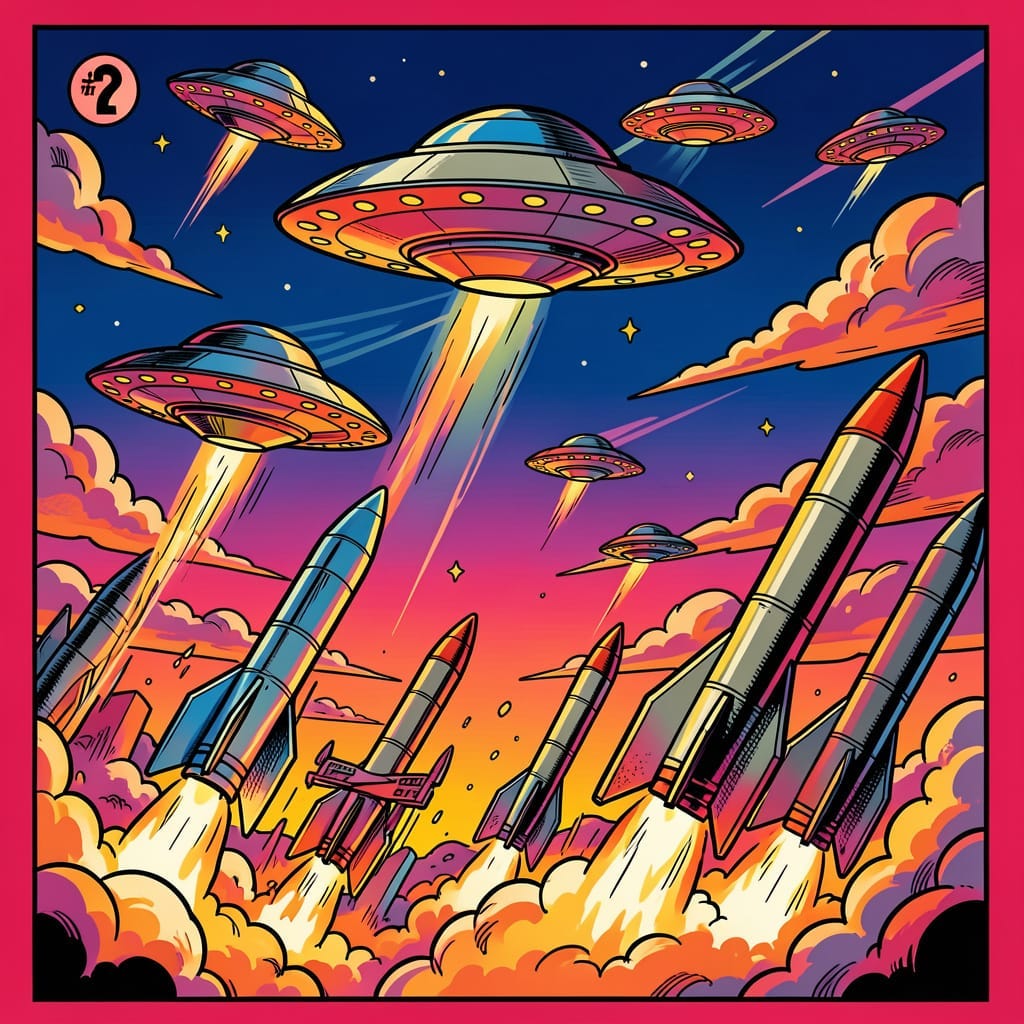
Still, some of you with a predilection for the paranormal might wonder if aliens like those that Eshed described wouldn’t intervene to prevent a nuclear exchange. After all, a group of former U.S. Air Force personnel held a press conference in 2010 at the National Press Club claiming that unidentified flying objects (UFOs) had interfered with nuclear weapons systems. Former Capt. Robert Salas described a 1967 incident at Malmstrom Air Force Base in which 10 intercontinental ballistic missiles reportedly became inoperative as a glowing object hovered nearby. Retired officers also referenced the 1980 Rendlesham Forest incident near RAF Bentwaters and Woodbridge in England, where military personnel reported seeing a triangular craft, unusual ground markings, and unexplained lights. Some speakers said their reports were dismissed or classified as “top secret.” Researcher Robert Hastings, who organized the event, suggested the phenomena indicated extraterrestrials were monitoring nuclear weapons as a warning to humanity. However, the Pentagon had theretofore insisted that it cannot substantiate the existence of extraterrestrial craft.
So here we are. On one hand: retired Israeli officials describing a “Galactic Federation,” former U.S. presidents flirting with alien rhetoric, and the Pentagon promising document dumps about extraterrestrials. On the other: carrier strike groups repositioning, ten-day ultimatums, recycled nuclear countdown clocks, and a region that could ignite in ways that would not be confined to the desert.
While we are invited to contemplate life on Mars, very real human beings are contemplating life under sanctions, drone surveillance, and missile defense systems. While social media debates whether UFOs disable nukes out of cosmic benevolence, oil tankers still pass through the Strait of Hormuz under the shadow of war games. While headlines ask whether humanity is ready for interstellar diplomacy, Washington appears ready—again—for regime diplomacy by other means.
That’s the pattern that The Whitest Kids U’Know sketch understood intuitively: when the press conference gets weird, check the flight radar. Because these “disclosures” aren’t really about extraterrestrials: they’re about narrative management.
If there were truly a Galactic Federation observing us, one imagines they wouldn’t be confused by our technology, but by our storytelling: by our ability to recycle urgency, our talent for turning distraction into doctrine, and our habit of announcing existential threats on a loop until they become background noise.
Most likely, no alien intervention is coming to prevent escalation in the Persian Gulf. No triangular craft will descend and hit the off-switch on imperialism. If war comes—or if it is narrowly avoided—it will be because human beings made those decisions, calculated those risks, and bore those consequences.
Which leaves us with something much less cinematic but far more important: attention. Attention to carrier movements, to economic warfare, to how “imminent threats” age, and above all, to who benefits when the spotlight shifts upward.
Maybe that’s the real first contact—recognizing that we are not being visited, but managed. Not invaded from space, but shepherded through narratives. Not distracted by accident, but by design.
Welcome back to Earth.
If mass hysteria hasn't happened over the last sixty years of US imperialism around the world, then some space alien stopping by won't register either.
I think the biggest threat to the USA are the crew on the USS Gerald Ford clogging up the toilets. Supposedly the problem is all the stuff that people have been flushing down the toilet like T-Shirts (??). Who does that? lol