

ICE Meltdown
Minneapolis bulletin

As you might have heard, earlier this week Officer Jonathan Ross of U.S. Immigration and Customs Enforcement (ICE) shot and killed 37-year-old U.S. citizen (and mother of three) Renee Nicole Good between East 33rd and East 34th Streets on Portland Avenue in Central Minneapolis. Good’s death has since inflamed national controversy, sparked widespread protests, and made headlines across the country. Video footage obtained from multiple angles—including cellphone video from Ross himself—shows an interaction in which ICE officers approached Good’s vehicle as she was stopped diagonally in the roadway during an enforcement action. An agent shouting orders reached toward the vehicle, and Ross shot Good as she attempted to drive away. Good’s vehicle then crashed further down the block, and she was pronounced dead at the scene.
Federal authorities initially released limited details, and have framed Good’s actions as a threat to ICE agents—President Donald Trump claimed that she “viciously ran over the ICE Officer”—though this characterization has been challenged by local officials and independent video analysis. (Ross was involved in a prior vehicle-related incident in June 2025, during which a motorist refused to exit during a stop and dragged him approximately 300 feet, possibly providing relevant context for his later threat perception.) In the aftermath, the federal government’s handling of the investigation has drawn criticism: state authorities, including Minnesota Governor Tim Walz and Minneapolis Mayor Jacob Frey, have disputed parts of the federal narrative and called for transparent review of the evidence. The FBI is reportedly leading the probe, and state and local agencies have expressed frustration over restricted access to key material.
Public response has been immediate and intense: protests have taken place in Minneapolis and are being organized in cities nationwide, often calling for ICE accountability and raising broader concerns about federal law-enforcement tactics. The incident has become a flashpoint in the larger national conversation on policing, immigration enforcement, and civil liberties, with tensions between federal and local officials further complicating efforts to reach a common understanding of the facts on the ground.
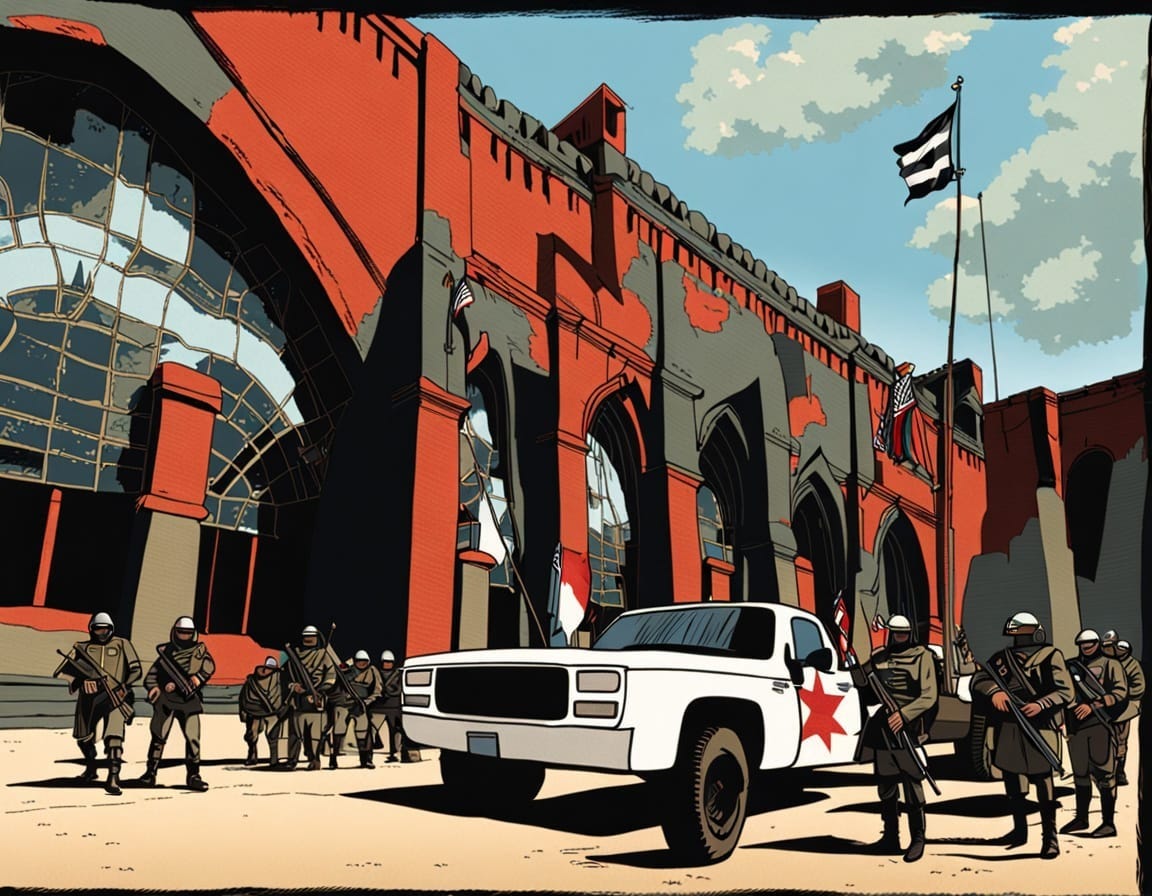
Longtime Radio Free Pizza gourmets may note this as an escalation of the city’s more longstanding tensions with policing and civil liberties, recalling our January 2024 dispatch that traced the long shadow of the late-May 2020 unrest following George Floyd’s death, when protests escalated into riots, the Minneapolis 3rd Precinct was abandoned on orders and then burned, and more than a thousand properties were damaged. We detailed how the aftermath has been marked not only by material destruction but by a lingering civic demoralization, sharp disagreements over policing, and a persistent sense among residents that public safety has deteriorated. More recent aficionados of our reporting might also remember last year’s journal describing renewed fears about political violence, then made concrete by the politically motivated killing of Minnesota lawmakers unfolding amid nationwide unrest, protests against immigration enforcement (”What else is new?”) and a polarizing military parade in Washington that symbolized deep national division.
Accordingly, we can certainly call it fitting that broader conflicts between state and federal governments might here find a potential flashpoint. (If that should become the case, then perhaps we shouldn’t have stopped short of predicting it in a slice from the start of 2024 that noted how American society has become increasingly primed—psychologically, politically, and culturally—for internal conflict, whether sparked by a singular catalyst or from pressures already built into the system.) This killing, then, may well provide a litmus test for how authority, accountability, and restraint are exercised when federal power meets local resistance on the ground. For now, however, open questions remain about the precise sequence of events, the decisions made by the officers on the scene, and how federal use-of-force policies are interpreted and applied in dynamic, high-stakes encounters. To shed light on these questions, we turn now to the analysis of Rev. Augustus Corbett, Esq.
Here, Corbett explains (at ~6:40) the foundational decision in Tennessee v. Garner (1985) establishing that, under the Fourth Amendment, police officers may use deadly force to prevent escape only if they have good faith belief the suspect poses significant threat of death or serious physical injury to officers or others. He emphasizes this case forms the starting point for legal analysis in all law enforcement deadly force situations, noting that officers should not kill suspects merely to prevent escape unless the threat condition is met.
From there, Corbett goes on to detail (at ~8:45) Graham v. Connor (1989), which set the governing “objective reasonableness” standard for evaluating police use of force. Under this framework, actions are judged from the perspective of a reasonable officer on the scene, accounting for the fact that officers often make split-second decisions under tense and uncertain conditions. Of course, he points out (at ~19:20) the difficulty of prosecuting law enforcement officers, citing built-in protections from Supreme Court precedent and jury bias favoring police, noting that most cases aren’t even indicted—and even if Minnesota files state charges, Ross may receive Supremacy Clause immunity under the precedent of In re Neagle (1890), which may protect federal officers performing lawful duties if they reasonably believed their conduct was necessary. To determine if Ross has that immunity, courts must consider the totality of circumstances, including the severity of the alleged crime, whether the suspect posed an immediate threat, and whether the suspect was actively resisting or attempting to flee. Corbett emphasizes that this analysis explicitly excludes the officer’s subjective intent—whether good or bad—as well as hindsight judgments informed by slow-motion video review.
Applying these principles (at ~23:15) to the available video, Corbett focuses heavily on the direction of the vehicle’s front tires at key moments, arguing that still frames appear to show the tires turned away from the officer rather than toward him, suggesting that the vehicle’s movement was oriented away from the officer’s position. Corbett therefore notes that if the tires had been pointed directly at the officer, the government would have a far stronger argument that deadly force was justified. Instead, the available imagery raises questions about whether an imminent threat existed at the moment shots were fired.
Corbett further observes (at ~30:00) from video frames that at the moment of his first shot, Ross’s feet were not positioned directly in front of the vehicle, appearing to have space to move aside rather than fire, which weakens claims of immediate danger. He also addresses what may have been a second shot, arguing that if fired after the vehicle was clearly moving away and no threat remained, justification under Tennessee v. Garner and Graham v. Connor would be even more constrained. Examining (at ~35:03) wider video shots showing no apparent bystanders in the vicinity who would have been endangered if the officer had allowed Good to escape, Corbett notes that—since the vehicle was moving away from the officer and no one else appeared to be at risk—the use of deadly force wasn’t justified under Tennessee v. Garner. However, he acknowledges that Graham v. Connor factors still apply, providing built-in protections for law enforcers.
Beyond the strictly legal analysis, the case has also exposed how rapidly questions of use of force become subsumed into broader moral and political narratives. In a separate commentary, Glenn Greenwald examines the same footage and public reaction not to adjudicate the shooting itself, but to interrogate how different factions have responded to it—particularly the tendency, across the ideological spectrum, to justify or even celebrate death when it befalls perceived political enemies.
Here, Greenwald details how conservatives have pointed to Ross’s own footage as evidence that the agent reasonably feared for his life and therefore acted in self-defense, while critics argue the video instead shows the driver turning away to flee rather than attempting to strike the agent, making the use of lethal force unjustified. Greenwald emphasizes that although the driver and her partner had behaved antagonistically toward officers before the shooting, adversarial or disrespectful speech at a protest is constitutionally protected and cannot, on its own, justify deadly force. He also highlights contextual details about the victim—who reportedly had no meaningful criminal record—to argue that the leap from protest behavior to an assumption of homicidal intent toward officers is unsupported.
Greenwald then widens the lens (at ~1:54) to examine reactions across the media and political spectrum. On parts of the right, he observed a shift from legal arguments about use of force to overt dehumanization of the victim, including inflammatory labels, emphasis on her sexual orientation, and narratives portraying the agent as heroic for supposedly “saving” the child from her parents. Some political figures escalated further, referring to the victim as a “domestic terrorist” or implying she deserved to die. On the left and center, the shooting was broadly condemned as murder, but Greenwald draws a parallel to past instances in which online commentators celebrated the on-camera killing of Charlie Kirk, underscoring that the celebration of political opponents’ deaths is not confined to any one ideological camp. He stresses the importance of distinguishing between legitimate criticism of public figures and the moral collapse represented by rejoicing in someone’s death, noting with concern that expressions of mere criticism are often punished more harshly than explicit celebrations of violence.
At the core of his analysis, Greenwald critiques (at ~8:53) what he describes as a broader societal coarsening and dehumanization of political adversaries, accelerated by polarized media ecosystems, online anonymity, and groupthink. He links this domestic moral erosion to U.S. foreign policy, arguing that a nation perpetually engaged in war must continually dehumanize external enemies, a habit that eventually seeps back into domestic culture. Citing Martin Luther King Jr.’s 1967 Riverside Church speech, Greenwald argues that violence abroad and violence at home are morally and psychologically connected.
Greenwald further challenges what he describes as an inconsistent pro-law-enforcement standard embraced by some on the right: that if a person defies lawful orders and an officer reasonably fears for their life, lethal force is justified. Applying that logic consistently, he argues (at ~21:25), would imply that Capitol Police should have used far more lethal force against violent participants on 6 January 2021. Of course, many of these same voices would reject that conclusion, revealing a politically selective application of principle. For Greenwald, both the Minnesota shooting and the killing of Ashli Babbitt on 6 January fail the same ethical test: deadly force should be an absolute last resort. He concludes that the gravest danger lies not in disagreement over individual cases, but in the abandonment of consistent moral standards altogether—replaced instead by factional judgments about who deserves to live or die. In his view, resisting that trend requires reaffirming strict thresholds for lethal force, rejecting the dehumanization of political opponents, and refusing opportunistic double standards driven by partisan loyalty.
Taken all together, Greenwald’s analysis situates the Minneapolis killing within a wider cultural pattern of dehumanization, selective outrage, and inconsistent standards for lethal force, in response to which one must ask what kind of society is being shaped by how we talk about who deserves to live or die.
In the end, Good’s killing cannot be responsibly reduced to a slogan, a clip, or a partisan verdict rendered in advance of full evidence. As Corbett’s legal analysis makes clear, the governing standards for deadly force are demanding by design, precisely because the power to kill in the name of the state must remain exceptional, constrained, and accountable. At the same time, as Greenwald’s broader critique underscores, the danger does not lie only in whether this single shooting meets a legal threshold, but in how readily Americans now sort such deaths into moral categories based on political allegiance—excusing, condemning, or even celebrating them accordingly. If this case is indeed a litmus test, it is not only for federal use-of-force policy or intergovernmental friction, but for whether a society already strained by violence, polarization, and mistrust can still insist on consistent principles, sober judgment, and the basic sanctity of human life. Until the facts are fully known, restraint—legal, moral, and rhetorical—remains the only position compatible with justice rather than faction.