

Ends of the Embargo
Cuba bulletin

With the U.S.-Israeli war on the Islamic Republic of Iran entering its eighth week, and a U.S. blockade of the Strait of Hormuz aimed at starving Iran of its oil income now entering its third, the logic of economic strangulation has once again moved to the center of American foreign policy. Of course, some would say it never left—particularly those in the Republic of Cuba, which has been the target of that policy not for weeks or months, but for more than sixty years. In Cuba, that logic has long since ceased to appear as a discrete policy decision, but has become a condition of life.
Last month, the island’s electrical grid collapsed again: another in a series of nationwide blackouts that have left millions without power, with the ongoing U.S. oil blockade—which intensified after January’s kidnapping of Venezuelan President Nicolás Maduro, whose administration had been supplying Cuba with oil—having cut off shipments to the island for extended periods. With Cuba faces a worsening humanitarian crisis resulting from the restricted fuel access, high-level talks in Havana between the U.S. and Cuba began earlier this month, though both sides have disputed what was said behind closed doors. U.S. officials have signaled that the island’s leadership faces a narrowing window to implement reforms, with some reports suggesting a two-week timeline tied to the release of political prisoners—claims Cuban officials have denied even as they acknowledge the meetings. Washington maintains that a diplomatic resolution remains possible under the Trump Administration, but the substance of those discussions suggests that material pressure is being leveraged to extract political concessions.
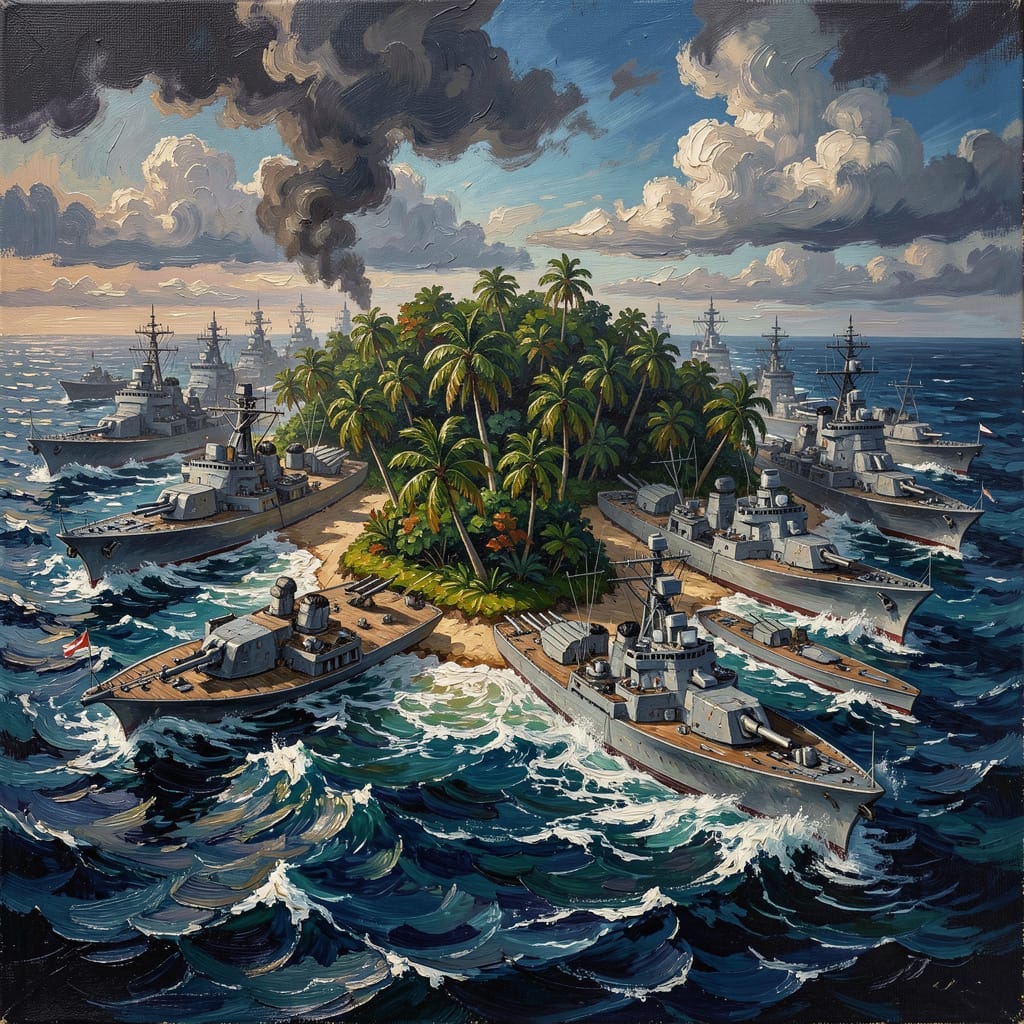
Then, just last night, a U.S. Senate vote legitimized growing concern in Washington that U.S. policy toward Cuba may be drifting toward open conflict. Lawmakers blocked debate on a War Powers resolution that would have required congressional authorization for any military action against the island, even as some members argued that the ongoing U.S. energy blockade already constitutes a form of “hostilities.” The measure’s sponsors warned that the Trump Administration is effectively pursuing regime change, citing escalating rhetoric and reports that military options are under consideration.
While some officials and analysts suggest that negotiations between Washington and Havana could still produce a diplomatic breakthrough, others argue that current U.S. policy is less about negotiation than coercion—using economic and energy pressure to force political transformation. But the congressional failure to produce a War Powers resolution suggests that, if deteriorating living conditions to demands for political reform, then U.S. policy will shift toward explicit regime change—realizing U.S. President Donald Trump’s prediction last month that he will have “the honor of taking Cuba.”
With fuel restrictions collapsing the island’s economy and amplifying the empire’s leverage at the negotiating table, then the blackouts begin to read not as unintended consequences, but as instruments—conditions through which political concessions, and ultimately regime change, are meant to be compelled. Cuba’s energy system depends on imported fuel to run its aging thermal power plants, and without oil, the plants shut down. When the plants shut down, the grid collapses, and everything else follows: food spoils without refrigeration, hospital patients die in blackouts, and water utilities stop functioning. Scarcity compounds across sectors, turning a supply problem into a systemic one.
But to fully understand the blackouts, the empty shelves, and the grinding scarcity that defines daily life in Cuba today, we have to return to the origin of the policy that still structures that reality more than sixty years later. Because President Trump’s oil blockade represents only the latest turn of the screw in the country’s decades-long embargo against its former economic colony.
In 1959, following the Cuban Revolution, the new government moved to nationalize major industries—many of them owned by American firms. Washington responded not with a single decisive break, but with a series of tightening economic measures. By 1960, the Eisenhower Administration had imposed partial trade restrictions, cutting off key exports and restricting most commerce between the two countries.
The decisive turn came in February 1962, when John F. Kennedy formalized a near-total embargo on trade with Cuba—effectively severing the island from its largest historical trading partner. Of course, the U.S. escalation unfolded not only through economic policy, but through covert military action: in 1961, the U.S. backed the failed Bay of Pigs Invasion, an attempt to overthrow the Cuban government by force that ended in rapid defeat and lasting hostility. In March of following year, Pentagon officials drafted Operation Northwoods, a now-declassified proposal for a false-flag operation that would result in the deaths of U.S. citizens to justify military intervention—plans that were never approved, but which reveal the extent to which confrontation with Cuba had moved beyond diplomacy into the realm of contingency for direct conflict.
Such a confrontation became even riskier when, just seven months after that proposal, the world came within reach of direct superpower conflict during the Cuban Missile Crisis following the discovery of Soviet nuclear missiles stationed on the island. The crisis ended with their removal, but it did not normalize relations. Instead, it entrenched Cuba’s position as a permanent security concern in Washington’s strategic thinking. The embargo, already in place, took on a new function—not merely as retaliation for nationalization or ideological opposition, but as part of a long-term containment posture.
Taken together, these episodes underscore that the embargo did not emerge in isolation, but as one instrument within a broader strategy of pressure, destabilization, and attempted regime change conceived during the Cold War. Even after the collapse of the Soviet Union, the long-term strategy persisted: to isolate the Cuban economy and force political change. Over the subsequent decades, the embargo was not merely maintained—it was codified, expanded, and internationalized. Laws like the Cuban Democracy Act of 1992 and the Helms–Burton Act of 1996 extended its reach beyond U.S. borders, penalizing foreign companies that attempted to do business with Cuba. The result was not just a restriction on trade with the U.S., but a constraint on the island’s access to global markets, finance, and supply chains.
In the absence of stable access to global markets, Cuba has not remained entirely cut off. Still, what has emerged in place of normal economic exchange is not recovery, but improvisation: in March, an international coalition of activists delivered humanitarian aid to the island by sea and air, attempting to circumvent restrictions that have choked off conventional supply lines. Organized by the Nuestra America Convoy, the shipment—totaling roughly 20 tons of food, medicine, and basic equipment—represented a show of global solidarity. But it also revealed the scale of the gap it seeks to fill. In a country of more than eleven million people, such deliveries cannot meaningfully stabilize food systems, restore electrical capacity, or sustain medical infrastructure. They exist not as alternatives to normal trade, but as evidence that normal trade has been disrupted.
Meanwhile, Russia has signaled that it will continue—and potentially expand—fuel shipments to Cuba, positioning itself as a key backstop to the island’s energy crisis. Following talks in Havana, Russian Deputy Foreign Minister Sergey Ryabkov emphasized that Moscow would not scale back its support, framing additional oil deliveries as part of a broader effort to offset the effects of U.S. sanctions and chronic energy shortages. A March shipment of roughly 730,000 barrels of oil—enough to cover only a few weeks of demand—underscored both the scale of Cuba’s dependence on external fuel and the insufficiency of ad hoc relief. While U.S. officials have allowed limited deliveries under temporary exemptions, Washington has otherwise maintained pressure on the island’s energy supply, even as Russia signals its intent to deepen its strategic presence in the region rather than withdraw from it.
What emerges, taken together, is not a picture of isolation overcome, but of isolation managed at the margins. Fuel arrives, but not reliably. Aid arrives, but not at scale. Each workaround addresses a symptom, while leaving the underlying constraint intact. The embargo bends, but it does not break; and so the blackouts continue.
At a certain point, the question is no longer how the embargo works, but why it persists. Because the conditions now defining life in Cuba aren’t the product of a single decision, or even a single administration, but the accumulated result of a policy that has been maintained, adjusted, and reimposed across decades, long after the geopolitical moment that gave rise to it has passed. Accordingly, its persistence suggests that what we are seeing in Cuba is not a deviation from the policy’s purpose, but its most complete expression.
With that in mind, what we are now witnessing in real time in the Strait of Hormuz represents in some senses an accelerated example of the same strategy as the U.S. embargo of Cuba: after a failed military campaign with the Bay of Pigs Invasion, the empire restricted its hostilities to the economic sphere—just as its campaign against the Islamic Republic seems now doomed by the rapid depletion of U.S. military stockpiles. But Cuba doesn’t have the same oil reserves with which to sustain its industries in economic isolation. Instead, pressure accumulates under the embargo that, once sufficiently concentrated, demands release.
However, that release does not have to take the form of negotiation over intervention. If the rhetoric now emerging from Washington gives us any indication, Cuba may soon find itself once again the target of a military strike—perhaps one that the U.S. will justify as a humanitarian relief and liberation of an oppressed people (as it did when it first launched its war on Iran) of the very conditions it imposed—pointing toward a trajectory in which economic strangulation is not an endpoint, but a preparatory stage: a system designed to weaken, isolate, and destabilize over time, until the conditions become ripe enough for military action.
What Cuba reveals, then, is not only what the embargo is, or how it works, but what it becomes over time: not a temporary measure of pressure, but a durable system—one that outlasts the conflicts that produced it, reshapes the conditions it acts upon, and, in doing so, generates its own rationale for continuation. In that sense, the line between economic coercion and military intervention is not fixed, but a fluid continuum along which pressure is applied, accumulated, and, when deemed ample enough, converted into force. If that pattern holds, then the question is no longer whether the U.S. intends to escalate, but when it will decide that the conditions its embargo produced have become sufficient to justify doing so: when, that is, that the Cuban people have suffered enough that the U.S. can pose as their savior.
If that moment arrives, it will not mark a departure from policy, but its culmination. The embargo will have prepared the ground. In the end, what may appear as intervention on behalf of the Cuban people will instead reveal itself as the sole aim of the same strategy that made such an intervention seem justified in the first place.