


In the past month, the Somali community of Minnesota—the largest outside Africa—has faced heightened tension after President Donald Trump launched repeated attacks against Somali immigrants, threatened to revoke their legal protections, and supported upcoming immigration enforcement actions targeting the community. Conservatives like President Trump have used isolated fraud cases to malign Somalis broadly, intensifying scrutiny of the community and fear within it.
At the risk of sounding heartless, we could say that the community (particularly its elders) probably finds the feeling familiar. Following the start of the Somali Civil War in 1991, refugees were initially resettled across the country, but soon began arriving in Minnesota because of its reputation for effective refugee support, a stable economy, and perceived safety and kindness. Many more later moved to Minnesota through “secondary arrivals,” drawn by family connections, strong refugee resettlement agencies, and economic opportunity. Today, about 84,000 Somali Americans live in the state, with a large share U.S.-born and the vast majority holding U.S. citizenship.
Of course, perceived kindness means vulnerability to exploitation, and allegations of fraud seem well-founded: the largest case, Feeding Our Future, involves a COVID-era scheme in which defendants claimed to feed millions of children but instead diverted funds. (Compared to the scheme that was the pandemic itself, this one is at a scale we might call “cute.”) Overall fraud losses across multiple cases could exceed $1 billion, according to prosecutors’ estimates from early December, though more recent estimates put the figure at $9 billion. Most of the defendants—more than 90% across the major cases—are of Somali descent, though prosecutors note the alleged ringleader in the largest case was a white American woman.
In addition to labeling Minnesota’s Somalis as “garbage,” President Trump and conservative outlets have suggested fraud proceeds may have funded Al-Shabaab, the Somali terrorist organization that has for two decades wreaked havoc across the country, but Treasury Secretary Scott Bessent acknowledged that investigators have so far found no evidence to support terrorism allegations, and no such charges have been filed.
Naturally, Rep. Ilhan Omar (D-MN), the first Somali American elected to Congress, condemned Trump’s remarks as racist and dangerous. Community leaders describe themselves and their fellow Somalis as “under siege,” but note strong support from Twin Cities leadership and resilience within the community. Nonetheless, most Somali Americans in Minnesota continue to face deep socioeconomic challenges: a majority live in poverty or near-poverty, with low median incomes, lower educational attainment, and low homeownership rates compared to other groups. Many small businesses struggle to survive, and language barriers remain common. Researchers and community leaders argue that these patterns resemble earlier immigrant groups and expect second-generation Somalis to achieve significantly better outcomes, but stress that persistent poverty within the community poses a long-term economic challenge for Minnesota as a whole.
Again, at the risk of sounding heartless, we could say that the Somali community (particularly its elders) is probably familiar with economic challenges: the estimated $9 billion in fraud sits at just under three-quarters of Somalia’s current GDP, with the country’s economy predictably handicapped after more than three decades of a civil war that has internally displaced more than 2 million Somalis, generated over 900,000 registered refugees in East Africa alone, and led to repeated famines that killed hundreds of thousands.
But Somalia’s long-running crisis is not simply the result of internal failure but has been deeply shaped—and worsened—by decades of foreign intervention, particularly by the U.S. and its allies, as historians like Elizabeth Schmidt of Loyola University of Maryland and documentaries like that from Africon Productions make clear.
Africon Productions begins its analysis (at ~1:37) with Somalia’s colonial roots during the late 19th century scramble for Africa. The British established a protectorate in the north (British Somaliland) in 1887, while Italians controlled the south (Italian Somaliland) in the 1880s and 1890s. France seized territory now known as Djibouti, while parts of the Somali population remained in what became Ethiopia and Kenya. This fragmentation inaugurated irredentist tensions that persist to this today, and inspired the resistance led by Sayyid Mohammed Abdullah Hassan, who conducted a 21-year rebellion (1899–1920) against British, Italian, and Ethiopian forces, seeking to unite all Somalis under one Islamic government. After World War II, Italian Somaliland came under UN trusteeship in 1950 while remaining under Italian administration, and British Somaliland gained internal autonomy in 1960.
The documentary goes on to detail (at ~3:24) British Somaliland’s independence on 26 June 1960, quickly followed by voluntary merger with Italian Somaliland on 1 July, forming the Somali Republic. Aden Abdulle Osman became the first president, and the unification was celebrated across the Somali world as a triumph of nationalist aspirations. The newly independent Somalia adopted a democratic system and aimed to promote unity, democracy, and Pan-Somali nationalism, though the dream of Greater Somalia including all Somali-inhabited regions led to tensions with neighboring Ethiopia and Kenya.
Despite these challenges, the 1960s represented a hopeful period when Somalia embraced self-rule, joined the United Nations, and pursued development and national pride before political instability and dictatorship derailed their vision. Detailing (at ~6:35) the aftermath of President Abdirashid Ali Shermarke’s 1969 assassination, the documentary describes how General Mohamed Siad Barre seized power in a bloodless coup. He then suspended the constitution, banned political parties, and declared Somalia a socialist state based on scientific socialism inspired by the Soviet Union and China. Initially, Barre’s regime achieved significant gains through literacy campaigns, infrastructure projects, and anti-corruption measures, positioning himself as a modernizer and Pan-Somali nationalist. However, despite publicly denouncing clanism as backward and divisive, his regime covertly relied on clan favoritism, serving his own Marehan clan (part of the larger Darod clan family) along with allied Ogaden and Dulbahante clans, forming the MOD alliance. State institutions, military, and intelligence services were dominated by these groups, deeply alienating other major clans, especially the Isaac in the north and Hawiye in central regions.
We learn next (at ~7:51) how Barre launched a military campaign in 1977 to annex Ethiopia’s Ogaden region, home to ethnic Somalis. Initially successful, Somalia’s army advanced deep into Ethiopian territory. However, the Soviet Union switched sides to support Ethiopia, providing massive military aid and facilitating support from Cuban troops, leading to Somalia’s decisive defeat. The Ogaden War proved disastrous both militarily and economically, humiliating the regime, discrediting Pan-Somali aspirations, and causing massive financial strain. Barre broke ties with the Soviet Union and aligned with the U.S., but the damage was irreversible. The war created thousands of refugees and displaced persons, straining local communities and government resources while causing many Somalis to lose faith in Barre’s leadership.
The aforementioned Schmidt describes how U.S. backing after the Ogaden War kept Barre in power despite widespread repression, corruption, and economic collapse. Once the Cold War ended, Washington withdrew its support and criticized Barre’s human rights abuses. Deprived of external backing, his regime fell in 1991, plunging Somalia into state collapse. Warlords and clan militias carved up the country, while Islamist organizations filled the vacuum by restoring basic law, order, and social services—gaining popular support in the process.
Africon Productions’ documentary also points (at ~9:07) to the role that competition over foreign aid played in fomenting and fueling the Somali Civil War. As Somalia entered a deep economic crisis in the 1980s, corruption became rampant as the elite, especially those linked to the ruling clan alliance, looted state resources and funneled foreign aid into private accounts rather than supporting development. When the central government collapsed in 1991, international humanitarian agencies rushed into Somalia to address famine and mass displacement.
However, with no functioning state authority, warlords and clan militias quickly moved to control ports, airports, and distribution centers where aid arrived. These groups seized shipments, taxed aid convoys, and used relief supplies as currency to buy weapons and recruit fighters. The struggle to dominate aid routes intensified rivalries between warlords like General Aidid and Ali Mahdi. Meanwhile, Schmidt adds, though the U.S.-led UN intervention in the early 1990s initially claimed humanitarian goals, it escalated into a military campaign against selected warlords, especially General Aidid—whose militia, the documentary tells us (at ~17:11), saw foreign troops as threats to his authority. Civilian casualties from airstrikes and raids provoked widespread hostility, culminating in the 1993 Battle of Mogadishu, where U.S. Rangers attempted to capture Aidid’s top lieutenants. The operation failed, resulting in 18 U.S. soldiers’ deaths and hundreds of Somali casualties. Images of a dead American soldier dragged through the streets shocked the world. By 1995, the U.S. and UN withdrew, admitting failure and abandoning Somalia to its warlords.
Following Aidid’s death in 1996, we learn (at ~18:15), no single faction could dominate Somalia, leaving the country fragmented. Clan-based administrations emerged in regions like Bay, Bakul, Jubaland, and Gedo, each run by local warlords or businessmen. Amid the chaos, Islamic courts based on Sharia law began gaining influence, initially as community-led efforts to provide justice and security where the state had failed. Over time, they united into the Islamic Courts Union (ICU). By 2006, the ICU controlled most of southern Somalia, including Mogadishu, bringing unprecedented stability. However, the ICU also had radical elements, with its leadership including figures accused of links to Al-Qaeda, and its rise alarming both Somalia’s Transitional Federal Government (TFG) and neighboring Ethiopia.
Schmidt here would hasten to add that, following the collapse of the World Trade Center on 11 September 2001, Somalia was re-cast through the lens of counterterrorism. The U.S. treated Islamist movements as inherently extremist, ignoring their social-service role and local legitimacy. For that reason, Washington backed both Ethiopia and Somali warlords, and propped up the TFG—which she characterizes as weak and corrupt—as Ethiopian troops invaded Somalia in December 2006 with TFG support and ousted the ICU within weeks. Subsequent U.S. strategy relied on “low-intensity warfare”: drone strikes, special forces, and private contractors. These tactics killed leaders but failed to dismantle the movement, instead fueling recruitment and spreading violence regionally, including attacks in Kenya.
As Africon Productions details (at ~20:30), the Ethiopian occupation was deeply unpopular among Somali residents, and consequently sparked a new insurgency. From the ICU’s ashes, the aforementioned Al-Shabaab (Harakat al-Shabaab al-Mujahideen)—originally a non-violent youth militia defending Islamic courts—emerged as an extremist jihadist group with global ambitions and Al-Qaeda allegiance. Al-Shabaab launched a fierce insurgency against the Ethiopian-backed TFG using guerrilla tactics, suicide bombings, and assassinations, gaining control of vast areas in southern and central Somalia. In 2009, facing heavy resistance and mounting casualties, Ethiopia withdrew from Somalia. The TFG similarly returned to Mogadishu, but remained weak as Al-Shabaab continued growing and imposed harsh Sharia law in controlled areas. In 2012, Al-Shabaab officially pledged allegiance to Al-Qaeda, becoming part of the global jihadist movement and recruiting foreign fighters from America, Europe, and East Africa.
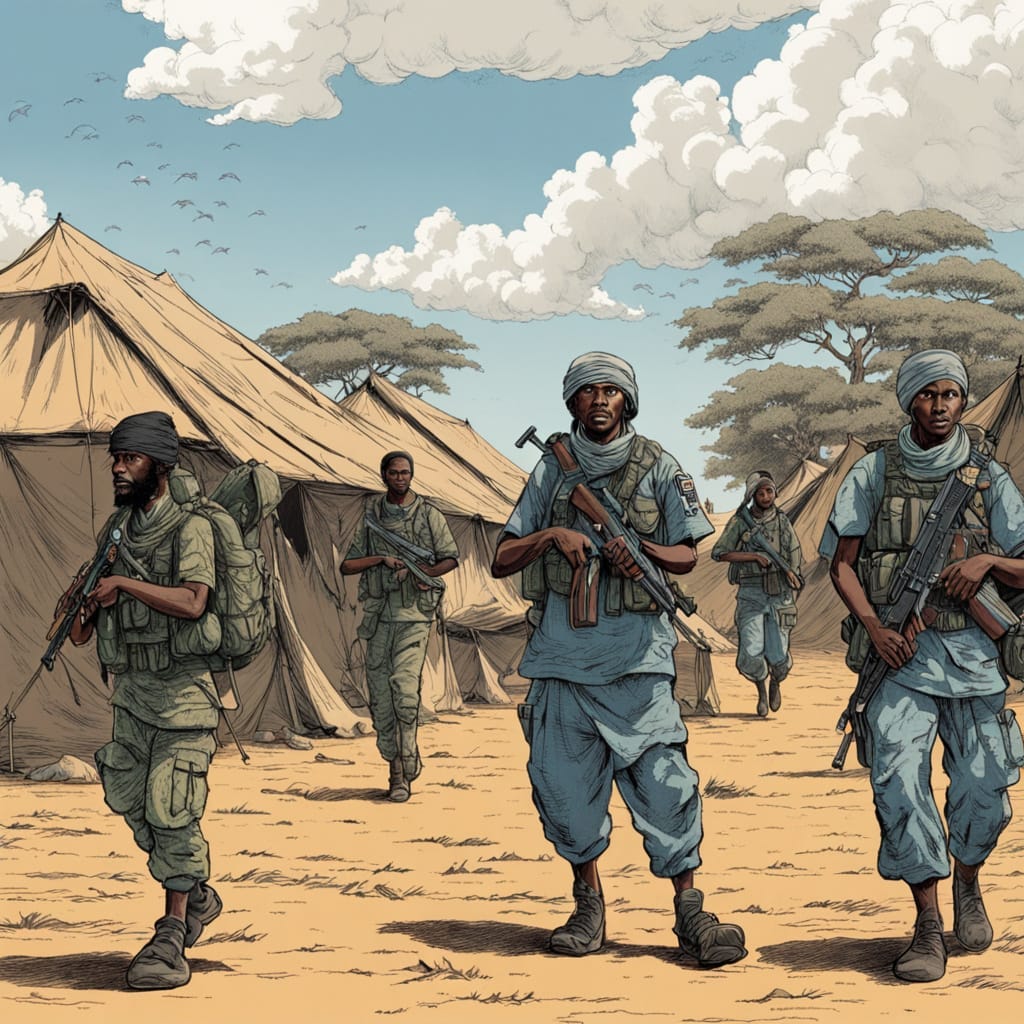
The documentary continues (at ~23:18) its discussion of the civil war’s devastating consequences, including the collapse of the country’s formal economy, with key sectors including banking, manufacturing, infrastructure, and public services destroyed. Major ports like Mogadishu and Kismayo fell under militia control, the national airline ceased operations, and roads and bridges were destroyed. Livestock trade, informal markets, remittances, and piracy became main income sources. Diaspora remittances, estimated at over $1.5 billion annually, became a vital economic lifeline for families relying on relatives abroad. Warlords, arms dealers, and smugglers built a war economy based on looting, extortion, and illegal trade of charcoal, arms, and people.
The conflict profoundly destabilized the Horn of Africa region, with Kenya facing major Somali refugee influxes, extremist cells, and deadly Al-Shabaab terrorist attacks. Its impact gained even greater geopolitical scope as piracy off the Somali coast became a global concern between 2005–2011, with armed Somali pirates hijacking commercial ships in the Gulf of Aden and Indian Ocean, demanding millions in ransom. Global shipping lanes were disrupted, requiring multinational naval force deployment to patrol Somali waters. The conflict fueled cross-border arms smuggling, human trafficking, and drug trade that affected Yemen and the Arabian Peninsula.
Africon Productions also details (at ~31:51) how the African Union Mission in Somalia (AMISOM) has played a critical role since 2007 in fighting Al-Shabaab and in stabilizing parts of the country. Thousands of African troops, primarily from Uganda, Burundi, Kenya, Ethiopia, and Djibouti, died in the mission. (We here at Radio Free Pizza wonder if the Alliance of Sahel States feels at all impressed, since the bloc departed the Economic Community of West African States [ECOWAS] in 2024 for its failure to effectively counter terrorism, and received consequent sanctions from the African Union.)
The documentary concludes optimistically (at ~33:51) that, despite devastating consequences lasting over three decades, signs of recovery are emerging in Somalia: a federal government exists, local administrations are functioning, and parts of the economy are rebounding, fueled by diaspora remittances and international aid. However, significant challenges remain with Al-Shabaab still active, political divisions persisting, and humanitarian needs remaining high. International efforts have often been criticized for being disjointed, overly militarized, and insensitive to Somali political realities, with Western backers supporting unpopular governments and peace-building initiatives failing to meaningfully include local stakeholders. Despite massive aid, Somalia remains heavily dependent on external support, and the withdrawal of AMISOM—first restructured as the African Union Transition Mission in Somalia (ATMIS) and now as the African Union Support and Stabilization Mission in Somalia (AUSSOM), whose current mandate expires one year from today—poses future risks. Nonetheless, one must certainly admire the resilience shown by the Somali people in enduring such immense suffering in their ongoing struggle to rebuild their nation.
Taken as a whole, the Somali experience illustrates how sustained U.S. intervention in foreign affairs—shaped less by local realities than by shifting geopolitical priorities—has repeatedly deepened instability rather than resolved it. From Cold War patronage that propped up an increasingly repressive dictatorship, to abrupt abandonment after strategic usefulness expired, to post-9/11 counterterrorism policies that conflated local governance with global jihad, U.S. actions consistently undermined Somali sovereignty and social cohesion. Military solutions displaced political ones; externally imposed governments displaced indigenous legitimacy; and short-term security objectives eclipsed long-term state-building. The rise of warlordism, the militarization of humanitarian aid, and the transformation of community-based Islamic courts into extremist insurgencies were not aberrations but predictable results of intervention policies that consequently perpetuated instability, marginalized grassroots peacekeeping efforts, and ensured that ordinary Somalis bore the ongoing cost of endless war.
Somalia’s decades-long suffering thus stands as a cautionary case: when U.S. power is exercised without accountability to local populations or respect for internal political processes, it does not merely fail to bring stability, but actively manufactures the very chaos it later claims to combat.
Seen in this fuller historical light, the social-services fraud now being weaponized against the Somali community in Minnesota is less an aberration than a downstream effect of prolonged foreign intervention and displacement. When a people shaped by humanitarian dependency, institutional vacuum, and predatory aid regimes are resettled into a wealthy state whose social programs are complex, under-supervised, and suddenly flush with emergency funds, some degree of exploitation is not surprising: it is structural. To treat such fraud as evidence of cultural pathology or moral failure is to erase the conditions that produced it, many of them authored or amplified by U.S. policy itself. If the U.S. wishes to prevent these outcomes, the remedy lies not in collective punishment or racialized scapegoating, but in reckoning honestly with how intervention abroad deforms incentives at home, and building systems—in both domestic and foreign policy—that emphasize accountability, inclusion, and dignity rather than extraction, suspicion, and spectacle.